Abstract
The development of a new generation of high-efficiency photovoltaic devices has intensified considerably in recent years, motivated by the objective of surpassing the Shockley–Queisser efficiency limit and achieving photovoltaic conversion efficiencies beyond 30%. Conventional strategies based on impurity doping to introduce intermediate electronic levels within the bandgap have yielded limited improvements due to enhanced non-radiative recombination.

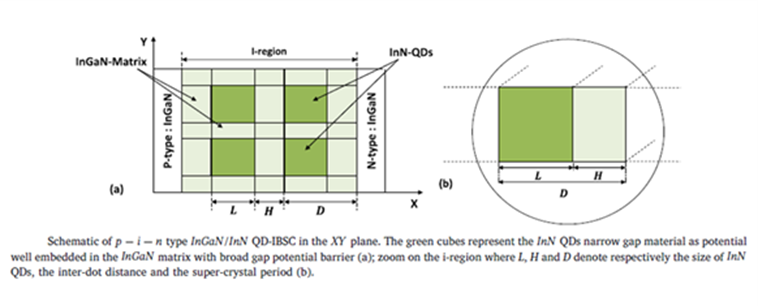
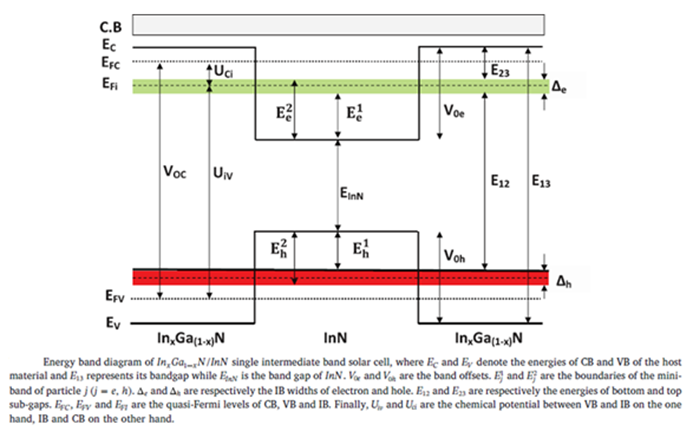
Recent advances in nanotechnology, particularly in the controlled growth and structural engineering of semiconductor nanomaterials, have enabled the incorporation of quantum dots (QDs) in the intrinsic region of solar cells, leading to the emergence of intermediate band solar cells (IBSCs). The discrete quantized states generated by QDs establish an intermediate band within the forbidden gap, facilitating the absorption of sub-bandgap photons and promoting electron transitions through a two-step excitation mechanism. This configuration contributes to a significant reduction in non-radiative losses and positions IBSCs as a promising architecture for exceeding the theoretical Shockley–Queisser limit while simultaneously lowering the levelized cost of photovoltaic electricity.
Despite this potential, the performance of IBSCs remains strongly dependent on the optimization of several design parameters, including the size, geometry, and inter-dot spacing of QDs, as well as the selection of suitable semiconductor materials. The position and width of the intermediate band induced by QD-related quantized states are typically determined by solving the Schrödinger equation within the effective mass approximation. These parameters critically affect key photovoltaic characteristics—such as open-circuit voltage, short-circuit current density, and overall conversion efficiency—highlighting the necessity for rigorous modelling and experimental validation. Within the framework of the MOPGA (Make Our Planet Great Again) 2025 research project, particular effort will be devoted to optimizing these parameters in order to enhance the operational performance of IBSCs. The project also aims to investigate novel semiconductor materials and to develop a functional prototype, thereby contributing to the advancement of next-generation high-efficiency photovoltaic technologies.
Partners
Professeur E. FEDDI, School of Applied and Engineering Physics, Mohammed VI Polytechnic University, Lot 660, Hay Moulay Rachid Ben Guerir, 43150, Morocco
LCP-A2MC, Université de Lorraine, ICPM, 1 Bd Arago, 57070 Metz, France
Contacts